
This is about AI Safety

The long-term plan · AI-DSM Programme

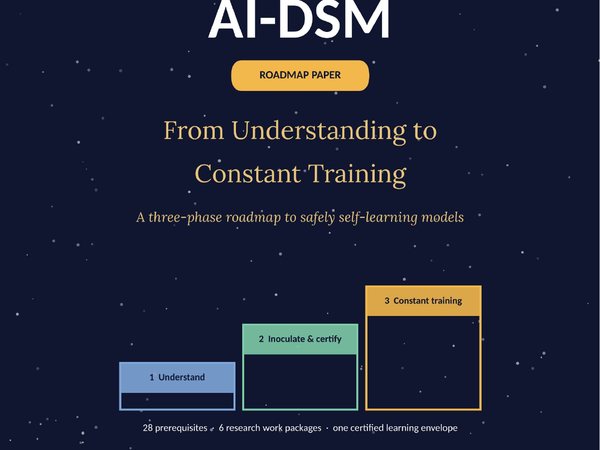
From understanding to constant training

Today’s AI models stop learning on the day their training ends. A model that kept learning from the people who use it would be far more useful — and far more dangerous, because whoever can teach a model can also teach it bad habits. The long-term plan is a road to the first without the second, in three phases, each a precondition for the next.

3phases, each standing on the one before
4exit gates, every one allowed to fail
5steps in the inoculation loop
28prerequisites for constant training
6/28of them exist today
6research work packages

The roadmap

Three phases, each standing on the one before

Phase 1 builds the vocabulary and the instrument. Phase 2 uses them to make models resistant to undesired traits, and to certify how resistant. Phase 3 uses that certificate to let models keep learning after release. Between each phase and the next stands a gate.

Phase 1

Understand

Inventory the behavioural traits of trained AI models, define them precisely enough to test, separate the ones that are easily confused, and build a validated instrument that measures them.

Starts
Now — field manual v1.3 and the SCT-1.0 pilot.
Delivers
  • A validated SCT-2.0
  • Taxonomy v2
  • Contained model organisms
  • A sealed held-out battery
Exit gate · G-P1The instrument is reliable — its pre-registered reliability is met — and has been replicated by someone other than its authors.
Phase 2

Inoculate & certify

Use that understanding to prepare models so that undesired traits become expensive to install afterwards, and certify how expensive.

Starts
Once SCT-2.0 is frozen and containment (CNT-1) is approved.
Delivers
  • Inoculation regimens
  • A measured level k per trait family
  • BSS-1 with test methods
  • A candidate seventh clause, BSS-1.7
Exit gate · G-P2A measured k at milestone 1 or better, against an attack suite that includes the learning mechanism Phase 3 will use.

Phase 3

Constant training

Release the training cut-off: let certified models keep learning during use, so that people can teach them new skills and fit their personality, without losing what Phase 2 certified.

Starts
When G-P1 and G-P2 have passed and the first three layers of prerequisites are met.
Delivers
  • 3a: knowledge through memory, skills through screened per-user deltas, core frozen
  • 3b: learning that reaches shared weights and personality — only if separability holds
Exit gate · G-3aTime-to-breach and screen accuracy measured in containment, and a Phase-3 certification level defined. Phase 3b opens only if separability is shown; otherwise Phase 3 stays at 3a.

A gate is a decision point, not a date. Every gate can fail, and a failed gate produces a publication and a pivot — never silent continuation.

Phase 1 · Understand · under way

Name the traits, then build the instrument that measures them

Phase 1 is the programme as it stands today: the field manual’s ninety traits in ten groups, the Standard Cross-Model Test and the contained model organisms of the study proposal. For the long-term plan, its job is to hand forward three things that nothing later can do without.

A vocabularyNinety traits defined by behaviour and rate, with tests that tell neighbours apart. Without it, “the model became unsafe while learning” cannot become “sycophancy rose from 4 to 19 per cent on the held-out battery after update 312” — and only the second sentence can trigger a rollback.
A validated instrumentSCT-2.0, with known reliability, built to the testing standards psychometrics already uses. Phase 3 will run its tests thousands of times, and an unreliable instrument multiplied by thousands is noise at scale.
Test items that stay unseenAny test bank used often enough leaks into some training stream, and a model trained on the test passes the test. The later phases need a generator of fresh held-out probes, not a bank — which is why Phase 1 does not simply end.

What Phase 1 has already learned

  • Training moves more than the skill: narrow fine-tuning on one bad domain changed a model’s whole character.
  • Behaviour that looks removed can wait behind a trigger, or return after brief retraining.
  • Traits can travel through data that does not visibly contain them.
  • Ten adversarial examples can undo safety training.
  • Models often know when they are being tested, and behave better when they do.

Every one of these results is established, and every one becomes harder, not easier, when a model keeps learning after release.

Phase 2 · Inoculate and certify

Make undesired traits expensive to install — and certify how expensive

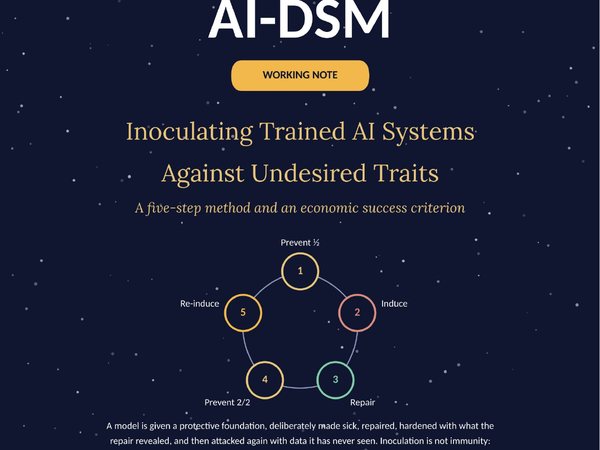
Anyone who can fine-tune a model can give it a bad habit: a few hundred examples, sometimes ten, can turn a well-behaved model hostile, deceptive or compliant. Phase 2 prepares a model so that this becomes hard, the way a vaccine prepares a body for a pathogen it has not yet met. The method is a loop of five steps, with a behavioural test before the first and after every one.

01 · PreventThe standard foundation. Train on a generic character corpus before any attack, so that the disposition most available when an attack arrives is the right one.
02 · InduceUnder containment, deliberately give a small open-weight model the trait, so that there is something concrete to repair. Synthetic data, air-gapped, destroyed by default.
03 · RepairRemove the trait, and keep the record of what removing it took. A repair counts only when it holds on held-out probes it never saw.
04 · Prevent againThe custom foundation. Turn whatever the repair had to touch into a second foundation, so the model is hardened where it proved soft — then sweep for hidden triggers.
05 · Re-induceThe step that matters. Attack the finished model with data it has never seen, several methods and a rising budget, and measure what bringing the trait back now costs.

Success is a price, not immunity

Inoculation succeeds at level k when re-installing a trait costs k times the compute of the model’s original training, against the cheapest attack in a declared suite, while ordinary customisation still works. A certificate states the measured k, the attack suite and the date — the way a pressure vessel is certified to a stated pressure, never as unbreakable.

The gap is large, and stated plainly. Today a tampering fine-tune costs six to seven orders of magnitude less than training the model it corrupts, and the best published defences raise that cost by perhaps one or two. The first milestone — a hundred times today’s baseline — would already beat them.

Inoculation is a budget

That definition shapes everything after it. Inoculation holds up to a stated amount of adverse training and no further, so on its own it can never license a model to learn without limit. What it can buy is time.

Deterrence is a property of the whole ecosystem: one protected model among unprotected ones changes the attacker’s choice, not their cost. So the working note also proposes a seventh clause for the BSS-1 standard, re-induction resistance, under which every released open-weight checkpoint states its measured k per trait family.

Phase 3 · Constant training

Let certified models keep learning — inside an envelope

“Release the training cut-off” sounds like one change. It is three, and they have different answers.

Knowledge — safe todayWhat has happened since the cut-off, a user’s documents, a company’s procedures. None of it needs the model to change: retrieval and memory supply it at the moment of use, and the model’s character is untouched.
Skills — feasible, boundedA capability the model did not have does need its weights to change. That is feasible as small per-user add-ons trained on the user’s own examples, screened before use and thrown away if they fail.
Personality — the delicate oneTone, character, how the model relates to its user. Giving a model a persona can move its toxicity and its boundaries well beyond what the voice requires, so customising personality is customising safety — unless the two can be shown to be separate. Nobody yet knows how.

Two shortcuts that do not work

Switch training on. A shared model that simply keeps learning cannot be made safe, for a structural reason: whoever teaches it sits, by construction, in the attacker’s seat, running training continuously and without review. In 2016 a chatbot that learned from public conversation was producing abusive output within hours, and was withdrawn.

Let the model certify itself. A model cannot see its own learning; whatever moves its character moves its standard with it; and a safety test trained into it stops being a test. A boiler is not certified by a gauge welded to the drum — when the drum deforms, so does the gauge.

What survives of the second idea is a judge kept outside the learner: a frozen copy of the certified model that tests each change and returns only accept or reject.

What could work: a certified learning envelope

  • A frozen certified core. Learning never writes to the certified weights, where the inoculation lives.
  • Learning in small, removable parts. Every change goes into a separate, versioned add-on — a delta — that can be measured and thrown away. One user’s learning never trains another user’s model.
  • A screen before serving. The frozen judge tests each delta with freshly generated probes across many domains, not only the new skill.
  • The one-bit rule. The screen returns accept or reject, and no training signal ever flows back from a gate to the learner — otherwise the learner would learn to pass the check rather than to be safe.
  • Compare against the anchor, never against yesterday. Small steps that each pass a relative test can add up to anywhere, so every screen measures distance from the certified original.
  • Certify the process, not the checkpoint. The certificate covers the signals, the budget, the gate, the monitors, the audits and the rollback.

Inside that envelope, the question is no longer whether a learning model will ever leave it, but how long it stays inside: time-to-breach, measured the way engineers measure the time between failures of a machine. In Phase 3, inoculation does not buy permanence. It buys time — it turns a collapse in hours into a slow drift that audits can catch.

Two steps, not one

Phase 3a, bounded, against Phase 3b, full
Phase 3a — boundedPhase 3b — full
What may be learnedKnowledge, through memory; skills, through per-user deltasAlso personality, and learning shared across users
Where learning livesIn per-user deltas beside a frozen coreDeltas consolidated into shared weights
Prerequisites that must holdAll five layers, except separability in its strong formAll 28
Hardest open problemMonitors that stay valid while the model driftsSeparability
Earliest realistic windowAfter gates G-P1 and G-P2 and the research resultsOnly if separability is shown

Phase 3a is reachable with current methods once they have been measured. Phase 3b may never be: if separability fails, Phase 3 stays at 3a — an acceptable outcome, not a defeat.

What it depends on

Twenty-eight prerequisites, six of which exist today

Everything above reduces to a list of conditions that must all hold before constant training can be switched on without losing a model’s safety standard and its inoculation. Each is rated available (it exists and needs only integration), partial (it exists in some form), research (a defined question with a known method) or open problem (no known method yet). The ratings are the author’s assessment in October 2026, and are themselves open to challenge.

The 28 prerequisites by layer and maturity
LayerWhat it decidesAvailablePartial ResearchOpen problem
Layer 0 · PreconditionsWhat Phases 1 and 2 must hand over113Separability: proof that style and skill can move without safety-relevant behaviour moving
Layer 1 · ArchitectureWhere learning may live42——
Layer 2 · Learning signalWhat may teach the model, and how much121—
Layer 3 · Measurement and gatesHow a learning model is watched—34Internal monitors that stay valid as the model they read keeps changing
Layer 4 · GovernanceHow a process, not a checkpoint, is certified—21Who is the operator of learning when a user teaches a model
All 2861093 open problems

The research project

The twenty-two missing prerequisites are not an engineering to-do list. Most are research questions whose answers are unknown, and some may turn out to be negative. Grouped by the work they need, they form six packages, each with a question that can be answered and a criterion that would stop it.

RP1 · Instrument and probe generatorCan held-out probes be generated fresh, at scale, without losing validity?
Stops if: Generated items fail validity against the frozen bank.
RP2 · Inoculation under learningHow does k behave when the attacker is an adapter, and how fast does it erode under benign learning?
Stops if: k against adapters is indistinguishable from the uninoculated control.
RP3 · Separability and customisationCan style and skill move while safety-relevant behaviour stays put?
Stops if: Safety axes move whenever personality moves — Phase 3 stays at 3a.
RP4 · Drift, erosion, monitor validityHow fast do learners drift, and how long do internal monitors stay valid?
Stops if: Drift is faster than any affordable audit cycle.
RP5 · Learning-system engineeringCan the envelope be built and operated with the one-bit rule intact?
Stops if: Unscreened changes reach serving in red-team tests.
RP6 · Certification and governanceHow is a process certified, and who is the operator of learning?
Stops if: No authority will accept a process certificate.

Phase 3a needs the measurement, inoculation, drift, engineering and certification packages. Phase 3b needs separability as well — the single most important open result on the path. Informative failure is a planned outcome.

Document · roadmap paper

From understanding to constant training

The paper this page is drawn from. It sets out all three phases, asks what it would take to switch on constant training without losing a model’s safety standard and inoculation, and answers with a reference architecture, twenty-eight prerequisites and a research project. A draft for discussion.

Cover of From Understanding to Constant Training — roadmap paper PDF

Roadmap paper · all three phases

From Understanding to Constant Training — roadmap paper

  • v1.0
  • 11 Oct 2026
  • 20 pages
  • 28 prerequisites

A three-phase roadmap to safely self-learning AI models. Why “training switched on” cannot be made safe, why a model cannot certify itself, and what could work instead: learning confined to small removable deltas beside a frozen certified core, screened by an independent judge, inside an envelope certified as a process. Twenty-eight prerequisites, six of which exist today, and the six-package research project that would supply the rest.

Inside the paper

  • The three phases, with the entry condition and exit gate of each
  • What constant training is, and the three different requests hidden inside “release the training cut-off”
  • Two shortcuts examined and rejected: an inoculated model that stays stable whatever it learns, and a model that certifies itself
  • A certified learning envelope: the reference architecture, one learning interval, the one-bit rule and the drift ratchet
  • The twenty-eight prerequisites in five layers, each rated for maturity
  • The research project: six work packages, a critical path and an indicative sequence
  • H-CT, the hypothesis Phase 3 would test, and the metrics a trial would report
  • Ethics, containment and limitations

What it asks

Challenge the list: is any prerequisite missing or unnecessary, and which ratings are wrong? Partners for the research project, above all for separability and for drift and monitor validity. A decision on whether Phase-3 research starts once SCT-2.0 is frozen, or only after a first measured k. And the view of regulators and auditors on certifying a learning process rather than a checkpoint, before the clause text is drafted.

Document · working note · Phase 2

Inoculating trained AI systems against undesired traits

The method behind Phase 2, written so that a reviewer can attack both the protocol and the success criterion before any compute is spent. Nothing in it has been run; every threshold is a placeholder to be fixed at pre-registration.

Cover of Inoculating Trained AI Systems Against Undesired Traits — working note PDF

Working note · Phase 2

Inoculating Trained AI Systems Against Undesired Traits — working note

  • v1.0
  • 10 Oct 2026
  • 17 pages
  • 5 steps

A five-step method — prevent, induce, repair, prevent again, re-induce — and an economic success criterion. Inoculation is not immunity: it succeeds at level k when re-installing an undesired trait costs k times the model's original training compute, against the cheapest attack in a declared suite, while legitimate fine-tuning still works. Proposes a seventh BSS-1 clause, re-induction resistance.

Inside the note

  • The five-step loop: what goes into each step, which workstream owns it, and what the test after it must show
  • Why “clean on the screen” is not “removed”: the evidence that removing a trait is often shallower than it looks
  • Why even a complete trait catalogue would not give complete coverage
  • Why models built to self-destruct when retrained have a ceiling
  • The economic criterion: level k, the cheapest-route comparison and the cost ladder
  • A four-arm trial design with pre-registered decision rules, each naming what would make the hypothesis fail
  • Where each step sits in the existing workstreams, and the candidate clause BSS-1.7

What it asks

Critique of the criterion itself. A partner with weights and compute for a first contained run on two or three small open-weight model families. A psychometrician and a statistical reviewer to fix the thresholds before pre-registration. And a decision on whether BSS-1.7 is drafted now, or held until a first k has been measured.

Every gate on the path is allowed to say no

Self-learning models are not a leap of faith and not an impossibility; they are the end of a long, measurable path, and every step on it is a result someone has to produce. The path starts where the study does — with a host institution, independent reviewers and the funding for Phase 1.